
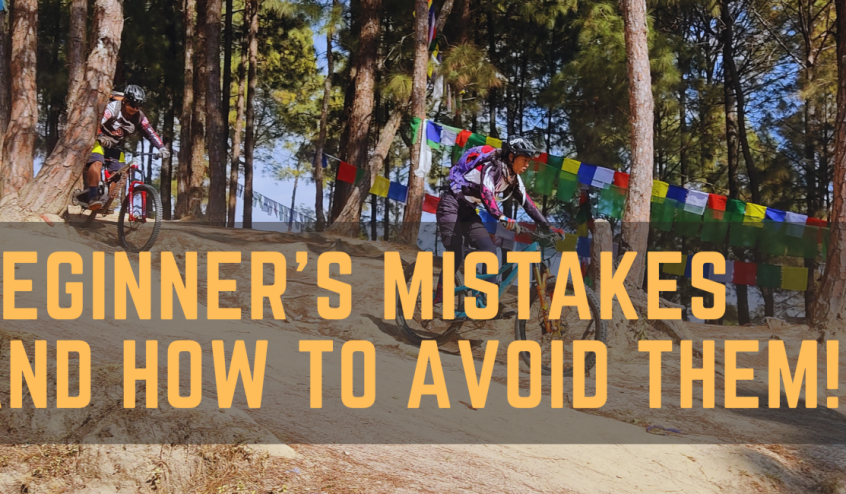
When you first start mountain biking, there’s a lot to learn, and it’s easy to choose bad habits and lose focus of the most crucial aspects. But don’t worry: we’ve put up a list of the 7 most common beginner mistakes and how to avoid them.
Make an effort to “read the trail ahead” by looking a long way up the trail. Examine the riding line to determine where you want your bike to be for the upcoming curves, hills, or obstacles. It gives you more time to think about what you’re going to do next on the trail. So, instead of gazing at the trees, rocks, or squirrels, focus on the course you want to go for the smoothest, fastest ride possible.

Balance is vital for any of the more advanced abilities you may wish to learn, and riding a bike in a variety of positions will allow you to guide your bike through and over trail hazards. It sounds easier than it is to balance on a mountain bike while it changes beneath you. While additional riding experience will enhance your balance over time, getting into the appropriate posture when better balance is required on rough terrain should be your first priority. Keep your head up and your gaze concentrated on your destination, not the location you’re attempting to avoid. Keep your elbows bent as you lower your shoulder toward the handlebars. Bending your elbows absorbs impact and allows you to move your bike side to side. To ride quicker parts of the technical trail, get out of the saddle and lift your backside. Maintain a slight bend in your knees and level pedals. The use of level pedals allows you to move your weight from side to side. Dropping one heel slightly below the axles gives a counter balance when you have to bend considerably.

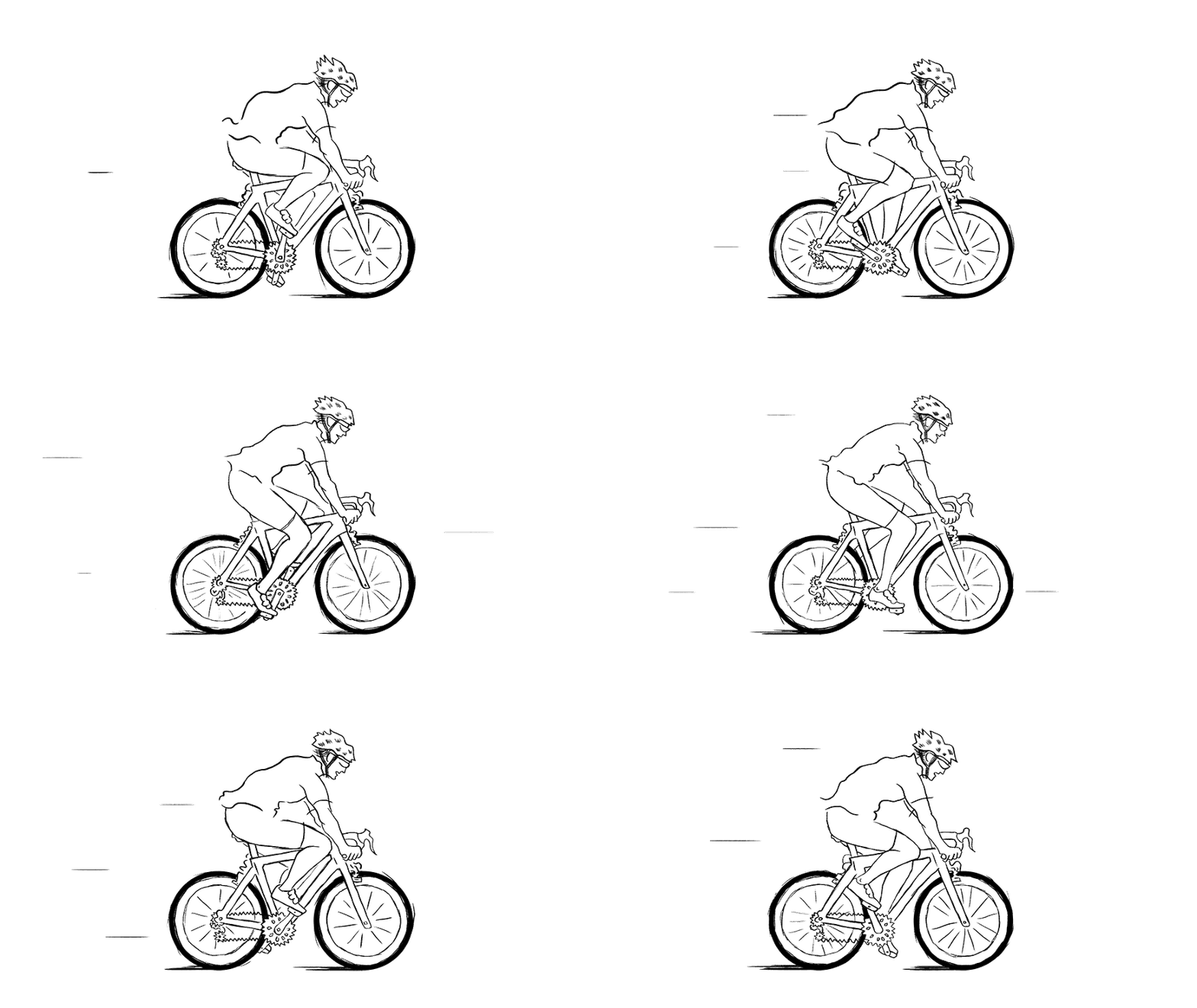
An effective pedal stroke is essential for conserving energy throughout your ride, ascending smoothly, sprinting quickly, and eventually getting over the major hurdles on your path. For new riders, achieving a firm circular power transfer in the pedal stroke will save you a lot of energy and make your ride much more enjoyable. Here are a few crucial points:
Proper cleat/foot position, saddle height Choosing the appropriate equipment, Make a circle.

Because most trailside dirt naps and well-known crashes occur when turning, this is an obvious subject to focus on next. Carrying a quicker speed into corners is also a great technique to save seconds off your overall time if you want to travel faster on your bike. The first time you feel the pressure of your body being forced into a berm at speed, you’ll probably let out an incoherent scream of delight, and you might become addicted to turning as quickly as possible.“ The proper approach to accelerate through a turn is to press down strongly with the outside pedal while the inside pedal is at the peak of the pedal stroke.

Beginners normally mistake good skills and tricks of MTB as showing off. These are the tricks you need to learn in order to progress your fundamentals. Also most riders are not naturally gifted at the activities they enjoy doing. Some people are drawn to highly skilled hobbies like mountain biking because they enjoy the challenge of learning and improving. Our ability to do anything well, frequently with desired effects, is loosely defined as a skill. Such skill takes a lot of practice, a lot of failure, a lot of adaptability, and eventually a lot of confidence. Oh, and don’t forget to include a fair dose of humility.

If any of you have ever attempted riding your bike on any trail, you have probably encountered a variety of obstacles such as rocky sections, mini gap jumps, drops or steep sections that can be frightening. In order to be able to ride those sections requires lots of commitments.
Commitment involves persisting with it and pushing oneself to complete things, which is not as simple as it may appear. This portion isn’t fun, and it’s where commitment is most prone to break down. However, this is also the time at which we regain control of our sails.
Before revisiting the larger feature, find a similar, less daunting feature that requires the same talents and master it. Working with a skilled skills coach can also help guarantee that you’re learning the fundamentals properly.